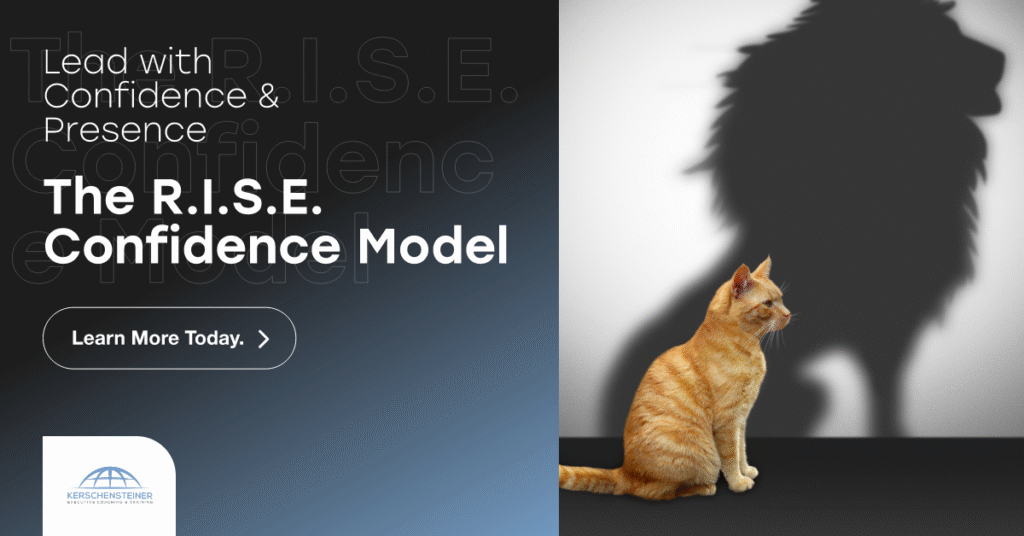
Most advice about leadership confidence focuses on hype: “be bold,” “believe in yourself,” or “fake it till you make it.” But leaders don’t need mantras — they need methods. Confidence isn’t a personality trait; it’s a capability that can be learned, practiced, and strengthened.
That’s why I built the RISE™ Confidence Framework — a practical, evidence-based system that helps leaders turn uncertainty into forward motion, especially in high-stakes moments.
The RISE™ Confidence Framework
RISE™ integrates leading research on self-efficacy, mindset, cognitive reframing, habits, self-other agreement, and performance psychology into four repeatable steps.
R — Reset the Narrative
Confidence begins with how we interpret setbacks, risk, and our own capabilities. Many leaders struggle not because they lack skill, but because their internal narrative reduces their willingness to try.
- Grounded In: Cognitive Behavioral Theory (Beck), Self-Compassion Research (Dr. Kristin Neff). These fields show that self-talk rooted in fear amplifies avoidance, while reframing thoughts into true, specific, and useful language increases resilience and performance
How to apply R:
- Name the fear-based thought in one sentence.
- Counter it with three facts (results, feedback, wins) that reinforce your capability.
- Replace the narrative with a neutral, controllable intention (e.g., “In this investor meeting, I will communicate the opportunity in 90 seconds with clarity and confidence.”)
This step shifts the brain out of threat mode and into control — setting the stage for confidence to grow.
I — Identify Real Evidence
Most confidence gaps are calibration gaps, not capability gaps. High achievers often underestimate themselves — a pattern well documented in Impostor Phenomenon research (Clance & Imes). Confidence accelerates when we anchor self-perception to evidence rather than emotion.
- Grounded In: Self-Efficacy Theory (Albert Bandura), Self–Other Agreement Research. Bandura found that mastery experiences are the strongest predictor of self-belief. Validating strengths through feedback (not just self-reflection) improves accuracy and confidence.
How to apply I:
- Build a “10 Proof Points” list of recent, specific wins.
- Ask two “truth-tellers” for one strength and one growth edge.
- Convert this into a skill hypothesis: “Given X strengths and Y proof points, I can deliver Z outcome under A conditions.”
This step creates confidence rooted in evidence, not ego.
S — Stretch with Micro-Bets
Confidence grows through action — but only when the action is small, intentional, and repeatable. Trying to take huge leaps often creates fear. Micro-bets, on the other hand, build momentum.
- Grounded In: Growth Mindset (Carol Dweck), Deliberate Practice (Anders Ericsson), Implementation Intentions (Peter Gollwitzer). Research shows that small, structured challenges create learning without triggering threat responses
- and “if-then” plans increase follow-through dramatically.
How to apply S:
- Define a 1–3% “stretch move” for this week — slightly uncomfortable, clearly observable.
- Create an if-then plan: “If I’m challenged, then I will pause, breathe, and restate my point once.”
- Afterward, debrief in 5 minutes: keep, adjust, or drop.
Through micro-bets, confidence shifts from theoretical to earned.
E — Embed the Wins
Temporary confidence fades if we don’t lock in the gains. Habit and performance science show that confidence becomes a default state when we track progress and ritualize success.
- Grounded In: Habit Formation Science (Wendy Wood), Psychological Capital (Fred Luthans), Autonomic Nervous System Regulation. To make confidence stick, the nervous system needs repetition, routine, and reinforcement — not motivation.
How to apply E:
- Do a weekly “Signal Review”: capture 3 micro-wins + 1 system adjustment.
- Create a Confidence Stack: a 60–90 second pre-performance ritual (breathing, cue phrase, first action).
- Track a simple Confidence Score (1–10) weekly to watch your trend improve.
This step moves confidence from occasional to automatic.
How RISE™ Fits Into the Leadership Navigation System™
RISE™ is one of the core “Leading Self” tools within the Leadership Navigation System™ (LNS) — a suite of evidence-based frameworks designed to help leaders master the inner and outer work of leadership.
If RISE™ builds internal confidence, the rest of the LNS ecosystem helps leaders direct that confidence with clarity, purpose, and impact.
Here’s how RISE™ integrates with other LNS tools:
- PACE™ (Time & Focus): Once confidence increases, leaders take bolder action — PACE ensures that action is intentional, strategic, and sustainable.
- INSIGHT™ (Critical Thinking & Self-Awareness): RISE™ builds belief; INSIGHT™ strengthens clarity and accuracy in how leaders interpret data, feedback, and their impact.
- CORE™ (Resilience): RISE™ helps leaders step forward; CORE™ helps them stay grounded and recover faster when they stumble.
- IMPACT™ (Communication): Confidence is only useful if it’s expressed effectively
- RISE™ enables the presence, IMPACT™ enables the delivery.
Within the Leadership Navigation System™, RISE™ acts as the ignition system: it gets leaders moving, speaking up, and taking the types of actions that unlock growth — for themselves, their teams, and their organizations.